Masjid and jami
The Arabic word for a mosque is masjid. It comes from sujud, which means bowing down in humility until your forehead touches the ground, so a masjid is literally “a place of prostration (sajda)”. Prostration is the most important part of the prayer.1
Another word, jami (Turkish cami), comes from the Arabic jāmiʿ, “the one that gathers”.1 A mosque brings believers together to pray as a congregation, above all for the Friday prayer (jumuʿa), which is always prayed together and includes a sermon.2
And [He revealed] that the masjids are for Allah, so do not invoke with Allah anyone.
(Qur’an 72:18)3
What a mosque is used for
Since the time of the Prophet, mosques have served several purposes.1
- They are places of worship. The congregational prayer is held here five times a day, and the Friday prayer on Fridays.
- They are places of learning. The Qur’an and the religious sciences are taught in mosques, and talks are given from the kürsü.4
- They are the centre of the community. In the early days of Islam, public matters were also discussed and decided in the mosque.
How Muslims pray in a mosque
- Before praying, everyone performs the ritual washing called wudu.5
- Each of the five daily prayers is announced by the call to prayer, the adhan.6
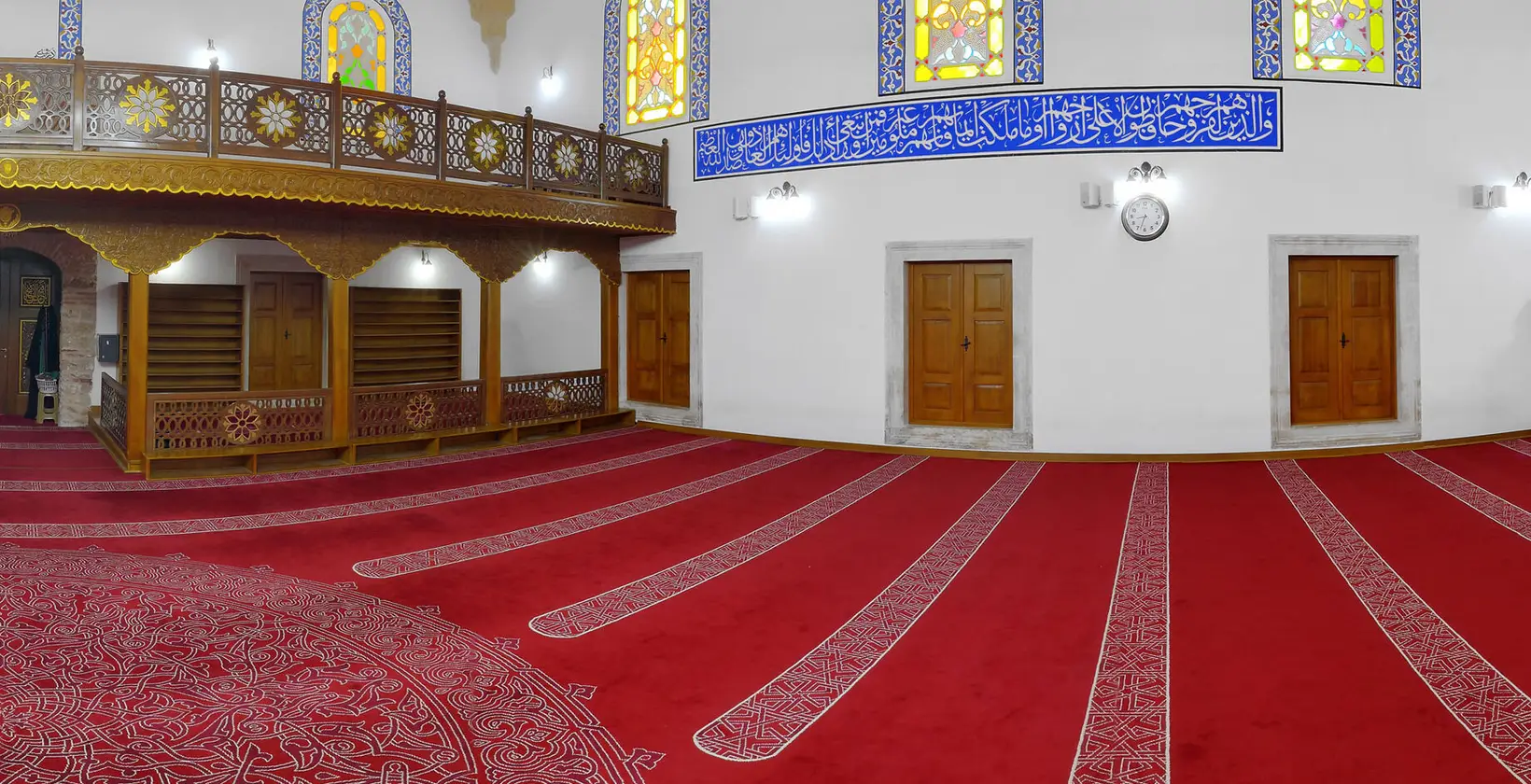
- Everyone faces the qibla, the direction of the Kaaba in Mecca.7 The mihrab, the niche in the front wall, shows which way that is.8
- The congregation stands behind the imam in straight rows, shoulder to shoulder, whatever each person’s position in life.
The mosques of Allah are only to be maintained by those who believe in Allah and the Last Day and establish prayer and give zakah and do not fear except Allah.
(Qur’an 9:18)3
Guests are welcome
Mosques are also open to people who are not Muslim and would like to see one from the inside or learn more about Islam. Banya Bashi welcomes tourists and curious Sofia residents all year round.9 Practical details are on the Visit page.
Footnotes
-
Ahmet Önkal, Nebi Bozkurt et al., “Cami”, TDV İslâm Ansiklopedisi, vol. 7, pp. 46–92. https://islamansiklopedisi.org.tr/cami ↩ ↩2 ↩3
-
Hayreddin Karaman, “Cuma”, TDV İslâm Ansiklopedisi, vol. 8, pp. 85–89. https://islamansiklopedisi.org.tr/cuma ↩
-
Qur’an quotations are from the Saheeh International translation of the meanings. https://quranenc.com/en/browse/english_saheeh ↩ ↩2
-
Yaşar Çoruhlu, “Kürsü”, TDV İslâm Ansiklopedisi, vol. 26, pp. 573–574. https://islamansiklopedisi.org.tr/kursu ↩
-
Abdülkadir Şener, “Abdest”, TDV İslâm Ansiklopedisi, vol. 1, pp. 68–70. https://islamansiklopedisi.org.tr/abdest ↩
-
Abdurrahman Çetin et al., “Ezan”, TDV İslâm Ansiklopedisi, vol. 12, pp. 36–43. https://islamansiklopedisi.org.tr/ezan ↩
-
“Kıble”, TDV İslâm Ansiklopedisi, vol. 25, pp. 364–369. https://islamansiklopedisi.org.tr/kible ↩
-
Tuğba Erzincan, “Mihrap”, TDV İslâm Ansiklopedisi, vol. 30, pp. 30–37. https://islamansiklopedisi.org.tr/mihrap ↩
-
Grand Mufti’s Office of Bulgaria, “Стотици хора посетиха столичната джамия „Баня баши“ в рамките на Европейски дни на наследството 2018” (Hundreds visited Banya Bashi during European Heritage Days 2018), 17 September 2018. https://www.grandmufti.bg/bg/up-to-date/novini/6545-stotitzi-hora-posetiha-stolichnata-dzhamiya-banya-bashi-v-ramkite-na-evropeiski-dni-na-nasledstvoto-2018.html ↩